

Table of Contents
If there were a version of you that always knew how to create, would you choose to live a creative life?
Maybe you’ve always known how to create. Remember when, as a child, you used to fill notebooks with stories, dance in your room when no one was watching, or spend entire afternoons building a world of your own making. That version of you didn’t wonder if they were creative enough. They just were.
And then the world had other plans.
Learning how to live a creative life looks different for everyone. And if you have ADHD or a neurodivergent mind, it can feel especially more challenging and complicated. The struggles you face don’t mean you’re less creative (it’s often more); it’s because the conventional paths to creativity weren’t designed with your brain in mind.
This in-depth guide is for the people who’ve been carrying a quiet creative yearning for longer than they’d like to admit. For the one who starts things but doesn’t finish them. For the one who has seventeen ideas before breakfast but can’t choose which one to pursue. For the one who used to make things and suddenly stopped because something new and shiny popped up in the middle of the way.
The Greeks have a word for what we’re after: Meraki. It means to pour yourself into what you do, which is to leave a piece of your soul in your work. Not for an audience. Not for money. Not for approval. But showing up fully as yourself and giving it your all is what you love, and its own kind of coming home.
This is a full guide to finding your way back there.
What does it mean to be a creative person?
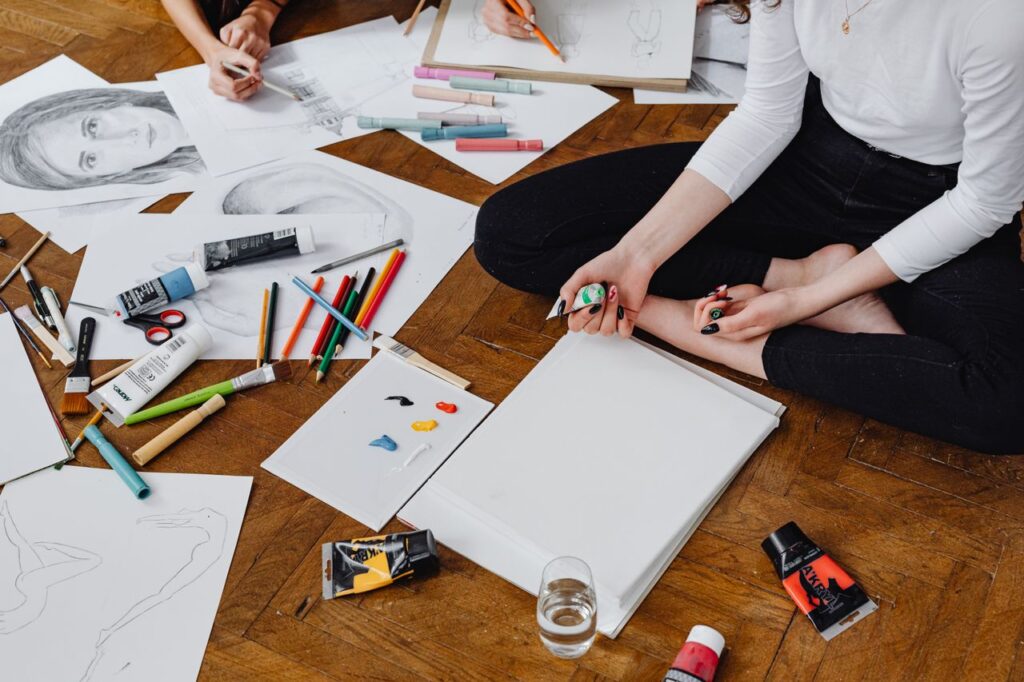
When people hear ‘creative’, they immediately picture a painter hunched over a canvas, a novelist working on a manuscript, a musician playing a melody, or an artist drawing still-life pictures. Creativity, in the popular imagination, belongs to the talented few.
But here’s the thing, living creatively isn’t only about what you make. It’s also about how you show up. It’s curiosity in the face of routine. It’s problem-solving that uses outside-the-box thinking. It’s the way you set a table, arrange your furniture, tell a story at dinner, or explore a path less traveled that nobody would ever consider.
Creativity is a way of being present with your own life. It is being engaging, expressive, and fully in the present moment.
Creativity isn’t a talent you either have or don’t. It’s a way of showing up for your own life. – Patti Digh
The spectrum of creative living is vast. It is writing, cooking, gardening, styling, building, connecting, teaching, observing, and more. If you pay attention to your life with intention and curiosity, you are already living creatively.
Why neurodivergent people are often more creative by nature
If you have ADHD or identify as neurodivergent, here’s something worth thinking about: your brain is not a broken version of a neurotypical mind. It works differently and often comes with unconventional and extraordinary gifts.
ADHD brains are wired for pattern recognition across unrelated fields. They make connections that more linear thinkers miss entirely. Being hyper-focused is one of their abilities. It’s a state of deep, absorbed attention that can produce creative output of startling depth and quality.
By nature, they seek novelty, which means they’re more drawn towards exploration, experimentation, and ideas that don’t conform to traditional senses.
Neurodivergent people have historically been overrepresented among artists, inventors, writers, musicians, visionaries, etc.
What Meraki means and how it applies to all creative acts
Meraki means pouring your soul into a creative practice. It doesn’t require talent, training, or a gallery show. It just needs your presence and fully engaging with what’s in front of you instead of going through the motions.
You can live with meraki while washing dishes, writing an email, having a conversation, or tending a small plant on your windowsill. The medium doesn’t matter. The quality of attention does.
Want to learn more? Read “What Meraki means and how to actually live by it every day”
Why so many of us stop creating and why it’s not our fault
To understand how to rediscover your creativity as an adult, it helps to understand what happened to it in the first place. Children create without question. They draw before they know they can’t draw, sing before they know they’re off-key, and build before they understand what won’t hold the structure together. There’s no gap between impulse and the act. They simply make use of their intuition.
Then school happens. Then criticism happens. Then the comparison happens. And somewhere in the middle of it, many of us received a message, either loud or subtle, that our creativity wasn’t good enough or worthy enough to receive approval or praise. That the things we made were not the things people wanted to see. That being different was a problem to be managed rather than a gift to be cultivated.
We learned to perform instead of express. We learned to produce instead of explore. And slowly, the creative making stopped.
ADHD-Specific Barriers to Creative Expression
For neurodivergent people, shutting down often stems deep because of cultural and neurological reasons.
- Executive Dysfunction makes it genuinely difficult to begin a creative project, even one you desperately want to start. The gap between intention and action can feel insurmountable
- Rejection sensitive dysphoria (RSD) is very common in ADHD. It means creative criticism doesn’t just sting; it can feel like reinforced evidence of fundamental unworthiness. One piece or consistent negative feedback can silence a creative person for years
- Time blindness makes it consistently hard to carve out and protect creative time. What feels like a lack of discipline is often a neurological difference in time perception
- Neurodivergent masking or performing neurotypically to fit in is exhausting. By the time many neurodivergent people have finished getting through the day, there is no energy left for creative expression
If any of these strikes a chord within you, the first thing to understand is this: you didn’t fail creativity. The system wasn’t designed to protect your neurodivergent mind.
The myth of waiting for the right conditions
Burnout, overwhelm, and the perpetual waiting for things to calm down before you create are patterns that will continue indefinitely if we don’t interrupt them intentionally. Creativity doesn’t arrive when conditions are perfect. Creativity comes when you make space for it to exist.
How to rediscover your creativity at any age
There’s no age that limits creativity. There’s no gap too long, no creative muscle too atrophied, no identity too far removed from ‘creative person’ to begin again.
But to return to the creative space, you have to start in the right place. And that isn’t ambition. Survival. Or Money. It’s play.
Start with exploration, not commitment
The pressure to immediately produce something good is one of the fastest ways to shut the creative door before you’ve stepped through it. Instead, begin with exploration. The open-ended, low-stakes, no-audience creative making that exists purely for the experience of creating.
Try a medium you’ve never tried before, but always wanted to. Take a photograph of something that catches your eye. Write a paragraph about yesterday’s conversation with a family member. Cook something without a recipe. Make something ugly on purpose. The point isn’t the output. The point is reopening the channel and awakening the creative spirit.
ADHD-Friendly re-entry points
If traditional approaches to rediscovering creativity (like committing to a daily practice) have felt impossible, there’s a reason, and it’s not weakness. ADHD brains are interest-based, not routine-based. They need novelty and intrinsic motivation to engage, not obligation.
- Short bursts over long sessions: fifteen minutes of making is more sustainable than three hours that never happen
- Novelty-based exploration: try something new regularly. The ADHD brain lights up for new stimulation
- Interest-led, not structure-led: follow what genuinely fascinates you, even if it changes week to week
- Sensory starting points: what textures, sounds, colors, or environments make you feel most alive and present? Begin there
Journaling Prompts for Rediscovering Your Creative Identity
If you’re not sure where to begin, these prompts can help you find the thread:
- What did you love making as a child, before anyone had opinions about it?
- When was the last time you lost track of time doing something you didn’t have to do?
- If no one would ever see it, what would you most want to make?
- What do people consistently ask for your help with that doesn’t feel like work to you?
- What kind of beauty stops you in your tracks?
How to build a creative practice from scratch
A creative practice isn’t a rigid schedule. It isn’t a perfectly curated studio. It isn’t an hour a day of productive output logged in a habit tracker app.
A creative practice is simply the commitment to return to your making, your expressing, your exploring. Do it consistently enough that it becomes a thread running through your life.
What that looks like will be different depending on how your brain is wired.
The Neurotypical approach: structure as a creative container
If your brain responds well to routine, structure can be a beautiful container for creative work. Some principles that work:
- Habit stacking: attach your creative practice to an existing habit. Write for fifteen minutes after your morning coffee. Sketch after dinner. The anchor habit carries the new one
- The fifteen-minute daily commitment: small and consistent beats ambitious and sporadic, every time. Fifteen minutes of writing every day produces more than three hours once a month
- A dedicated creative environment: a corner of a desk, a specific chair, a particular playlist. Environmental cues signal to your brain that it’s time to shift modes
- Accountability structures: a writing partner, a creative check-in with a friend, a public commitment. External structures support internal motivation
The ADHD and Neurodivergent Approach: Working with your brain and not against it
Here’s traditional habit advice: build a routine, show up every day, be consistent. Yet it often fails ADHD brains. Not because ADHD people are undisciplined, but because ADHD brains run on an interest-based nervous system rather than an importance-based one.
You cannot willpower your way into a creative practice that doesn’t feel intrinsically motivating. But you can design conditions that make showing up feel natural and low-resistance.
- Use hyperfocus windows intentionally: when you feel the pull toward deep engagement with something, protect that time. Don’t interrupt it with errands. Don’t schedule over it. Ride the wave as long as it lasts
- Body doubling for creative sessions: many ADHD brains find it significantly easier to work when someone else is physically or virtually present, just existing nearby. Virtual co-working sessions, coffee shop working, or a body-doubling app can make the difference between starting and not starting
- Lower the activation energy: keep your supplies visible and accessible. A journal on your desk is more likely to be written in than one stored in a drawer. Friction is the enemy of ADHD creativity
- The ‘good enough’ practice: perfectionism is a creativity killer for everyone, but for ADHD brains it can create a paralysis that prevents starting anything at all. Give yourself explicit permission to make things that aren’t very good. The practice is the point, not the product
- Time blindness workarounds: use timers to protect creative time rather than clocks. Set alarms that signal the start of a creative window, not just the end. A gentle alarm that says ‘now is your creative time’ can override time blindness in a way that abstract scheduling cannot
How to stop being afraid of your own creativity and begin anyway
Creative fear is real. The vulnerability of making something, of letting something that came from inside you exist in the world where others might see it and judge it, is one of the most genuinely exposed feelings a human being can have.
And for many of us, especially those with ADHD or a history of feeling different, the fear runs especially deep.
The Fear of Being Seen
There is a particular kind of courage required to share creative work. Not the courage of someone who knows they’re good. The courage of someone who isn’t sure yet, who is still becoming, who is making things that matter to them while not knowing whether they matter to anyone else.
This courage is not a personality trait you either have or don’t. It’s a muscle. And like any muscle, it builds through use, through small acts of creative visibility, practiced again and again until they become normal.
Rejection Sensitive Dysphoria and the Creative Person
For people with ADHD, rejection sensitive dysphoria is an intense emotional response to perceived criticism or rejection. It can make creative vulnerability feel genuinely dangerous rather than merely uncomfortable.
If creative criticism has ever felt like it hit you harder than it should have, harder than it seemed to hit other people, RSD may be part of the reason. This is not an emotional weakness. It’s a neurological reality.
Some strategies that help:
- Create for yourself first, always. Share only when you’ve given the work time to belong to you before it belongs to anyone else’s opinion
- Choose your audience carefully. Early creative work deserves a safe audience: people who can receive it with generosity rather than criticism
- Separate the work from your worth. What you make is not who you are. A piece that doesn’t land is not evidence of your failure. It is a piece that didn’t land. That’s all
The world needs what only you can make, but only if you actually make it. – Marie Forleo
The Messy First Draft Philosophy
There is no such thing as a good first draft. There are only first drafts that exist and first drafts that don’t. The ones that exist can be revised, improved, abandoned, or transformed. The ones that don’t exist cannot become anything at all.
Give yourself permission to be bad at something while you’re learning it. Permission to make ugly things while you’re finding your voice. Permission to start badly and continue anyway. The creative life is not built in the moments of inspired excellence. It’s built in the ordinary act of showing up and making something even when you’re not sure it’s any good.
How to make time for creativity when life feels too full
‘I don’t have time to create’ is one of the most common things people say and one of the most understandable. Life is genuinely full. Work and relationships and responsibilities and the endless administrative weight of being a functioning adult leave very little margin.
But here is the gentle, honest truth: for most of us, the time exists. What we mean when we say we don’t have time is often that we haven’t yet decided that our creative life is worth protecting.
Said with compassion, because this is not a failure of character. It is a pattern and patterns can be interrupted.
Micro-Creativity: The Power of Small Windows
You do not need two uninterrupted hours to create something meaningful. You need fifteen minutes you’ve decided to treat as sacred.
Morning pages (three pages of longhand stream-of-consciousness writing before the day begins) take about twenty minutes. A lunchbreak sketch. A voice memo of an idea captured while walking. An evening spent with a needle and thread, or a pot of paint, or a blank document.
Micro-creativity isn’t a consolation prize for people who can’t afford more time. It’s a legitimate and powerful way to keep the creative channel open between the larger, longer sessions.
The ADHD Time Blindness Challenge
If you have ADHD, protecting creative time faces an additional layer of difficulty: time blindness means that even when you’ve blocked time for creative work, it can disappear without you noticing.
- Use visual timers instead of clock-watching. A timer you can see makes the passage of time concrete rather than abstract
- Create environmental triggers that signal creative time. A specific candle you light, a playlist that only plays during creative sessions, a physical object you place on your desk. These external cues help bridge the gap between intention and action
- Batch creative work when possible. If you have a day where creative energy is high, do not save it for tomorrow. Tomorrow is not guaranteed to feel the same. Use what’s available when it’s available
Saying no to the energy drains that consistently crowd out your creative space is not selfishness. It’s stewardship of one of the most important resources you have.
What kind of creative are you? Finding your identity and owning it
One of the most freeing things you can do as a creative person is stop trying to figure out what kind of creative you’re supposed to be. Instead, start paying attention to what kind of creative you already are.
The Difference Between Creative Medium and Creative Identity
Your medium is what you use to create: words, images, food, fabric, sound, movement, space. Your creative identity is the thread that runs through everything you make, regardless of medium. The sensibility, the obsessions, the way you see the world that shows up whether you’re writing or cooking or arranging flowers on a table are what make you a creative.
Many people get stuck trying to find the right medium when what they actually need is to find the right thread. Once you find that thread, you’ll discover it was running through everything you’ve ever made.
Multipotentiality and the Neurodivergent Creative
If you have ADHD or are neurodivergent, you may have spent years feeling guilty about your inability to commit to a single creative path. You start things and then move on. You fall deeply in love with a medium and then lose interest. You have too many interests to choose between.
This is not a flaw. This is multipotentiality; the capacity for deep interest and engagement across multiple disciplines, and it is one of the most powerful creative gifts available.
The world has enough specialists. Multipotentialites see connections between things that specialists miss entirely. They bring the vocabulary of one field into another. They are, by nature, innovators.
You do not have to choose one thing. You have to find your throughline, the sensibility that connects all the things, and let that be your creative identity.
Why Creativity is Important for Mental Health
Creativity is not a luxury. For many people, and particularly for those with ADHD, anxiety, depression, or heightened emotional sensitivity, it is a genuine tool for mental and emotional wellbeing.
The research supports what creative people have known intuitively for centuries: making things helps us feel better. Not as a cure, not as a replacement for professional support, but as a practice that supports regulation, processing, and connection to the self.
Creativity as Nervous System Regulation
For neurodivergent people whose nervous systems are frequently dysregulated, overstimulated, overwhelmed, or cycling through emotional states faster than the environment around them, creative expression can function as a form of regulation.
The focused, absorptive quality of creative work, especially flow states and hyperfocus, activates the parasympathetic nervous system. In plain terms: making things calms a dysregulated brain in ways that talking about feelings often can’t.
Art-making, writing, music, and movement are not just hobbies. For sensitive and neurodivergent people, they are often medicine.
The Relationship Between ADHD, Anxiety, and Creative Outlets
ADHD and anxiety frequently co-occur, and creative expression offers something uniquely helpful for both: an absorbing external focus that quiets the internal noise.
When you are fully engaged in making something, the ruminating mind, the one that replays conversations and anticipates catastrophes and cannot find the off switch, has less space to operate. Creativity doesn’t eliminate anxiety, but it gives the anxious mind something to do with its energy that is generative rather than destructive.
A Note on Professional Support
Creative practice is a powerful complement to mental health care, but it is not a replacement for it. If you are struggling with mental health in ways that feel beyond what self-care can address, please reach out to a qualified professional. Your creative practice and your mental health support can coexist and reinforce each other beautifully.
What it means to live with Meraki: Pouring your soul into everything you do
We have traveled a long way through this guide, from understanding what creative living means, to recognizing why we lose touch with it, to rebuilding a practice that works for our particular brain and life.
And now we arrive at the heart of it: meraki.
Bringing Full Presence to Ordinary Acts
Meraki isn’t reserved for grand creative gestures. It lives in the texture of ordinary days, in the way you make a cup of tea, how you set a table, the attention you bring to a conversation, the care you fold into an email.
To live with meraki is to refuse to go through the motions. It’s to ask: what does it mean to do this particular thing, in this particular moment, with my whole self? And then to do it that way, even when no one is watching. Especially when no one is watching.
The Neurodivergent Version of Meraki
For ADHD and neurodivergent people, meraki has a particular resonance: hyperfocus is one of the purest expressions of doing something with your whole soul. The depth of engagement, the total absorption, the losing of time in something you love; this is meraki in its most concentrated form.
The goal isn’t to manufacture hyperfocus on demand. It’s to create the conditions where deep engagement becomes possible: by protecting your creative time, following your genuine interests, lowering the barriers to starting, and trusting that when the focus arrives, you are ready for it.
Small Daily Practices That Cultivate a Meraki Mindset
- Begin one thing each day with full, unhurried attention, even if that thing is just your morning coffee
- Notice beauty in the specific: the quality of light at a particular time of day, the weight of a pen you love, the smell of something that makes you feel at home
- Create without an audience regularly. Make things that only you will see, purely for the experience of making them
- Ask yourself, in the middle of ordinary tasks: am I here? And if the answer is no, gently return
How creativity and intentional living reinforce each other is one of the quiet discoveries of this kind of life: the more present you become, the more you notice what’s worth creating. The more you create, the more present you become. It is a self-sustaining cycle, and it begins with the smallest possible act of showing up.
You don’t have to be perfect at creativity. You just have to show up for it. – Elizabeth Gilbert
Conclusion: You don’t need everything figured out to begin
Wherever you are in your creative journey – whether you’re just beginning, coming back after a long absence, still figuring out what you want to make – you belong here.
And if your brain works differently, your ADHD is not a barrier to your creative life. It is a different kind of fuel for it. Your neurodivergent mind, with its pattern recognition and its hyperfocus and its insistence on following what genuinely fascinates it, is not broken. It is wired for a different kind of brilliance. One that the world genuinely needs.
You don’t have to be ready. You don’t have to be good. You don’t have to have your whole creative identity figured out before you’re allowed to begin.
You just have to start. And you belong here while you do.









Leave a Reply